Today.
I go home today.
I get to sit in my adapted chair
in my adapted home.
I get to sleep in my adapted bed
on my personally selected pillow.
I get to park my wheelchair
and sit at my desk.
I get to poo on a loo
of just the right height.
I get to shower in a shower
with soap that smells like heather.
I go home today.
And park the van we've rented
to use our car which we've adapted.
I get to go home today
And rest.
Until we leave again
On Monday.
Thursday, October 22, 2015


Wednesday, October 21, 2015
Being Seen
 |
| Photo Description: graphic with the words "Living in the MARGINS" with two arrows pointing to the margins. |
We got in and settled. A few minutes later a patron, who was sitting directly behind us, tapped Joe on his shoulder and said, "Could you please move him over to the far side, he's very tall." Joe said, "Ask him." A face turned to me and said, "You are very tall, could you sit over there, and pointed to the seat at the far side. I looked back at a theatre much less than half full. I looked at all the seats that there were for non disabled people to choose to sit. I said, "I'm going to stay here, but I'll get my other chair, I sit lower in it."
Joe zipped out to the car and got my manual chair, I sit 4 to 5 inches lower in that chair. While he was gone I moved my power chair out of the way and parked it. Joe came in, helped me transfer into the manual and then we went back to our seats. We figured that was that and we would settle into our seats.
A face comes forward, "I want you in the other seat, you are too tall."
I was shocked because there was no way that that patron couldn't see over me. The theatre had disabled seating immediately in front of a raised platform, the seats began there. You had to walk up stairs to get to the row behind. I said, "I am really sorry, but you have a lot of choices of where to sit. I don't. I'd like to sit here. If you would like to move up and back, please do. But this here, it's my seat."
A few seconds later we heard the patron move one seat over, behind Joe, closer to the centre of the screen. One seat over. We were asked to move way over to the side of the screen, and all that was needed was a shift of one seat.
When it was over we had to wait until nearly everyone was gone, while we waited, Joe went up to the seat behind me to see if I had really been in the way. He said that, from that vantage point looking at the screen, even down to the subtitles, I was not in the way. "I don't even the that you'd have been in the way in the power chair either," he said. Finally, it was clear enough so that we could get me back over to my chair, help me transfer in, and then leave.
So I wasn't asked to move because of sight lines, I was asked to move to be out of sight, off to the side, in the margins of the theatre.
How telling is that?
Tuesday, October 20, 2015
Way. Way. Better
Yesterday I was doing the keynote speech at a conference in Pennsylvania. When I had arrived at the hotel for check in I noticed that there were a lot of people with intellectual disabilities there and there was an excited buzz in the lobby and conference area. I went back to my room to prepare for my speech and I began to think about the keynote. I thought about how people with disabilities might feel in a room with a guy talking, no graphics, no power point, no visuals to amplify the material. So the next morning, before giving the speech, I spoke to the organizers and told them that when I was booked I didn't realize that I'd be speaking to an audience of both people with disabilities and those who support them.
I explained about how, when I have an integrated audience, I like to give an integrated keynote wherein I use both lecture and role play all at the same time. I take some of the stories and turn them into a skit and have people with disabilities, and others if necessary, volunteer to play out roles. She thought it was a great idea and gave me the go ahead.
I was nervous because these were all untried, just thought up, role plays and skits, and though there weren't a way lot of them, there were enough to make failure a true option. But I wanted to do it, I had been encouraged to do it ... so I did.
When it came to the first role play, which was to demonstrate that people with disabilities have to walk the walk they need to walk and that we support them in that walk; we don't take the walk from them. We don't take the experience way. We don't fight battles that aren't ours to fight. I asked for three volunteers and suddenly I had 10 people with disabilities up front with me. Quick adaption is the name of the game, so it was set up.
The audience and those doing the roll plays got into what they were doing and it was so much fun. When the volunteers took a bow, the audience roared their support. Then they made their way to their seats. All but one. A woman with Williams Syndrome stood alone, a few feet to my right. She was waiting for the others to sit. When they had, she gave a short but impassioned speech.
She talked about having a disability.
She talked about difference.
She said these things without even the slightest hint of shame or apology.
She stated that neither disability nor difference gave people a right to demean her and those like her.
She stated that she should be loved and accepted for who she was.
She made it clear that she expected a world that respected her.
It was brilliant.
I went back to the keynote with a renewed passion for what I was saying. I was so eager for the next time I asked for people with disabilities to participate in the keynote ... because, simply, they made it better.
Way.
Way.
Better.
I explained about how, when I have an integrated audience, I like to give an integrated keynote wherein I use both lecture and role play all at the same time. I take some of the stories and turn them into a skit and have people with disabilities, and others if necessary, volunteer to play out roles. She thought it was a great idea and gave me the go ahead.
I was nervous because these were all untried, just thought up, role plays and skits, and though there weren't a way lot of them, there were enough to make failure a true option. But I wanted to do it, I had been encouraged to do it ... so I did.
When it came to the first role play, which was to demonstrate that people with disabilities have to walk the walk they need to walk and that we support them in that walk; we don't take the walk from them. We don't take the experience way. We don't fight battles that aren't ours to fight. I asked for three volunteers and suddenly I had 10 people with disabilities up front with me. Quick adaption is the name of the game, so it was set up.
The audience and those doing the roll plays got into what they were doing and it was so much fun. When the volunteers took a bow, the audience roared their support. Then they made their way to their seats. All but one. A woman with Williams Syndrome stood alone, a few feet to my right. She was waiting for the others to sit. When they had, she gave a short but impassioned speech.
She talked about having a disability.
She talked about difference.
She said these things without even the slightest hint of shame or apology.
She stated that neither disability nor difference gave people a right to demean her and those like her.
She stated that she should be loved and accepted for who she was.
She made it clear that she expected a world that respected her.
It was brilliant.
I went back to the keynote with a renewed passion for what I was saying. I was so eager for the next time I asked for people with disabilities to participate in the keynote ... because, simply, they made it better.
Way.
Way.
Better.
Monday, October 19, 2015
A. C. (Annoyed Cripple)
So, I'm coming back to my hotel room. Down at the other end of the hallway a door opens and two people. dressed up for the evening, come out of their room and head towards me. As we get closer, I pull over to the right side, as they were walking on the left, to ensure that they had plenty of room to pass. I know they had plenty of room to pass, I'd gone by a loaded down housekeepers cart on my way by already.
Just before we meet, they startle the hell out of me by dashing in front of me, right in front of me, into an alcove created in the hallway at door entrances. I have to immediately pull to the left as now, if I continued straight, I'd hit them. Why? Because they are leaning out smiling at me. Faces shining because they've done something nice for me.
And I tell you.
I tell you true.
I couldn't do what they wanted.
I couldn't thank them.
Their faces looked at me in anticipation as I drew close and then shock when I went by, silently. They knew I'd seen them. Their gesture was obvious. I had wanted something from them - to walk by me normally, and they wanted something from me, to confirm that they are wonderful people.
Neither of us got what we wanted.
As Joe and I got out of the elevator we were talking about it. He'd seen it all happen because he's stepped behind me, giving them passing room, when we first saw them in the hallway.
I told him that they are just going to think I'm a bitter, ungrateful cripple.
I'm not.
I can be an annoyed, slightly pissed off, and even peevish, cripple.
I don't know what it was about this time that kept my mouth shut. Normally, I do say 'thanks' and acknowledge the effort.
But sometimes I cant.
You know?
Just before we meet, they startle the hell out of me by dashing in front of me, right in front of me, into an alcove created in the hallway at door entrances. I have to immediately pull to the left as now, if I continued straight, I'd hit them. Why? Because they are leaning out smiling at me. Faces shining because they've done something nice for me.
And I tell you.
I tell you true.
I couldn't do what they wanted.
I couldn't thank them.
Their faces looked at me in anticipation as I drew close and then shock when I went by, silently. They knew I'd seen them. Their gesture was obvious. I had wanted something from them - to walk by me normally, and they wanted something from me, to confirm that they are wonderful people.
Neither of us got what we wanted.
As Joe and I got out of the elevator we were talking about it. He'd seen it all happen because he's stepped behind me, giving them passing room, when we first saw them in the hallway.
I told him that they are just going to think I'm a bitter, ungrateful cripple.
I'm not.
I can be an annoyed, slightly pissed off, and even peevish, cripple.
I don't know what it was about this time that kept my mouth shut. Normally, I do say 'thanks' and acknowledge the effort.
But sometimes I cant.
You know?
Sunday, October 18, 2015
The Picture: The Story: The Man
 |
| Photo description: Justin Trudeau with Ruby and Sadie and me, take at Pride Day a couple years ago. |
I've met Justin Trudeau, briefly, twice over the last couple of years. As he is now fighting to become Canada's next Prime Minister, I wanted to write about those two meetings. The first was after Church on Church, which is a huge service held, yearly, by Metropolitan Community Church of Toronto. It is an event which a lot of community leaders attend. It's not uncommon to see leaders of both the Liberal Party and the New Democratic Party sitting right up front.
This picture was taken shortly after the service ended. Mr. Trudeau was passing by in front of me and I called out to him, asking him if he could pause for a picture with Ruby and Sadie. Though he was being rushed along by those surrounding him, he heard me. Looked over at me, and then something odd happened. He didn't simply dismiss my request. As a disabled fat man, I'm used to being disregarded and unheard, so I was taken aback. He had to shake off those insisting on him rushing out. He came over and I began organizing the picture of him with the kids. He said, "Well, why aren't you going to be in the picture?" I mumbled something about needing to take the picture and he laughed and said, "I've got people who can help with that." With that he handed the camera to one of the people with him and knelt down beside me, put his arm around the back of my chair and, when Ruby and Sadie were in place, the shot was taken. I thanked him, he graciously thanked me for wanting the picture.
I know this is the kind of thing that politicians do. But there was a genuineness in the interaction that left me feeling like Mr. Trudeau was a different sort of guy. Not a different sort of politician, but a different sort of person, one who managed to see difference differently.
The next time I met him was the following Pride day. We were going up Ted Rogers Way towards the gathering point for groups who were organizing themselves to be in the parade. I was slowly making my way up the sidewalk to join my group. Behind me surged a group of people carrying Liberal Party signs and wearing Liberal Party tee shirts. They were clearly rushing. They flowed by me, making it difficult for me to navigate, in my larger than normal, power chair. I felt very in the way.
I looked up at one young and earnest face and apologized, as I do, both because I'm disabled and used to apology and because I'm Canadian and it's in my \DNA. A voice spoke behind me. "You don't need to apologize, we do." I looked back and saw that it was Mr. Trudeau. As he approached me he stated that it was they who were rushing by me, it was them making the sidewalk overcrowded, I nodded and said, "Well everyone is rushing right now." He said that that was gracious of me but people needed to be respectful of my right to space too.
My right to space?
"Who," I thought, "Is this guy?"
We let me answer my own question. After closely following the election and watching the debates. This is the guy I voted for.
Both because of the policies he has put forward and because of two brief moments when Mr. Trudeau just became a guy named Justin who had no difficulty relating to a guy named Dave.
Saturday, October 17, 2015
Fire in My Tires
 |
| Photo Description: Logo for Firestone Complete Auto Care |
We left Toronto on this road trip knowing that my tires were dangerously low. As a result the steering became sluggish, carpets became really hard to navigate and backing up was powerfully slow. I knew, just knew, that we should have gone and got them filled where we usually go. I held back because that's the only place I go and I hate having to go and ask them a few times a year. Not because they raise a complaint but because I feel like I'm bothering them. People don't have to make you feel a bother for you to feel a bother.
Well, yesterday we were leaving a mall and I spotted a Firestone Store and, even though it was late and we were both tired, I, on impulse, said, "Let's go see if they will do my tires." Joe missed the turn into the store but we were determined now so we went round the block and found our way in. Joe pulled up by the entrance, went in, I saw him waiting in line to ask if they would do wheelchair tires. When he got to the front of the line, he was there only seconds. The man behind the desk, said they would help, no question.
We pulled up to where I thought I would get out but the mechanic just waved us over, had me unclamped while in the van so I could move around for him to get at the tires. First one side, then the other, and it was done. It's weird sitting in a chair that's getting tires pumped, You rise up on one side, then the other. We thanked him, he brushed off the thanks, and, after clamping me back down, we drove off with tires perfectly filled.
It's like driving a whole new chair.
The responsiveness is amazing.
I'd forgotten.
These guys who have filled my chair, and there have been many, over the six years I've had it, have, to a one, been decent people, glad to help.
Maybe my tires get low just so that I can be reminded of the basic human goodness of people. That asking for help needn't bring me low, or that, even if it did, I'd be pumped right back up.
Friday, October 16, 2015
Mountains!
Outside my hotel room window stands two maple trees which have been set ablaze by the season. They are surrounded by golds and greens and burgundies. I've been sitting, fingers on keyboard waiting to start tapping out the letters which will lead to a blog, looking out at the beauty of the Poconos for a really long time. Right now the world looks beautiful, and peaceful and serene. I need this.
A couple of days ago I was part of a panel that presented on the issue of abuse of people with disabilities within systems. The focus of the presentation was abuse prevention and how to create organizations that are safer for people with disabilities to live in. It was a resource rich presentation, binders full of information were given out, Four presenters, including myself, had three and a half hours to take people through approaches and strategies that are necessary for people to feel, and be, safe when receiving service.
I was pleased and proud to be part of the presentation. I admire my co-presenters and their passion. I was glad that the conference accepted the proposal for a pre-conference. I believe in the subject matter and it's ultimate importance.
Safety is the most important thing we do.
But I find these presentations, more than any others, wildly exhausting. We are talking about abuse, we are talking about the importance of safety. We are talking about people's lives. We are talking about hurt. We are talking about trust and trust violated. We are talking about things that matter deeply to me for deeply personal reasons.
I rushed from that presentation to another presentation without time to process what had happened and to take care of, forgive what will sound like melodrama, the 'wounded me.'
From the next presentation I rushed here, to this hotel, surrounded by trees impossibly beautiful. And I realized that I needed this beauty. I needed the world to look safe and serene.
Safety is the most important thing we do.
And it, like fall, will make the world beautiful.
A couple of days ago I was part of a panel that presented on the issue of abuse of people with disabilities within systems. The focus of the presentation was abuse prevention and how to create organizations that are safer for people with disabilities to live in. It was a resource rich presentation, binders full of information were given out, Four presenters, including myself, had three and a half hours to take people through approaches and strategies that are necessary for people to feel, and be, safe when receiving service.
I was pleased and proud to be part of the presentation. I admire my co-presenters and their passion. I was glad that the conference accepted the proposal for a pre-conference. I believe in the subject matter and it's ultimate importance.
Safety is the most important thing we do.
But I find these presentations, more than any others, wildly exhausting. We are talking about abuse, we are talking about the importance of safety. We are talking about people's lives. We are talking about hurt. We are talking about trust and trust violated. We are talking about things that matter deeply to me for deeply personal reasons.
I rushed from that presentation to another presentation without time to process what had happened and to take care of, forgive what will sound like melodrama, the 'wounded me.'
From the next presentation I rushed here, to this hotel, surrounded by trees impossibly beautiful. And I realized that I needed this beauty. I needed the world to look safe and serene.
Safety is the most important thing we do.
And it, like fall, will make the world beautiful.
Wednesday, October 14, 2015
Me ... I`m fine.
I no longer understand a simple question.
It seems like I have to run the question through a particular filter and then provide an answer to a question unasked.
`Wow,`was the response when I was telling a friend about my travels this month. They are extensive and I`m all over the place doing all sorts of things. We won`t be home except for a couple days in October. I like what I do, but I admit it`s tiring a fact which my friend picked up on and said. `That must be so hard on you, all the travel and the hotels and the restaurant food - I`d hate it. Don`t you get really tired.`
My answer, once I got started was about travelling with a wheelchair and about the access issues and about the attitudes we encounter. I stopped because I could see I was annoying her. `I didn`t ask for the disabled Travellers Chronicles,`she said, `I asked how YOU were doing. Just you.`
Oh.
Me.
As separate from my chair.
Just me.
She gets that there are issues with travel.
But she wanted to know how I was doing. How I was handling the travel stresses, not the ones that come with disabilities, but the regular ones. Stress in travel isn`t just a disability issue is it.
Sometimes people are asking just about that stuff.
I`m not sure it all can be separated out, I`ll have to think about that.
But it was nice to be asked.
About me.
It seems like I have to run the question through a particular filter and then provide an answer to a question unasked.
`Wow,`was the response when I was telling a friend about my travels this month. They are extensive and I`m all over the place doing all sorts of things. We won`t be home except for a couple days in October. I like what I do, but I admit it`s tiring a fact which my friend picked up on and said. `That must be so hard on you, all the travel and the hotels and the restaurant food - I`d hate it. Don`t you get really tired.`
My answer, once I got started was about travelling with a wheelchair and about the access issues and about the attitudes we encounter. I stopped because I could see I was annoying her. `I didn`t ask for the disabled Travellers Chronicles,`she said, `I asked how YOU were doing. Just you.`
Oh.
Me.
As separate from my chair.
Just me.
She gets that there are issues with travel.
But she wanted to know how I was doing. How I was handling the travel stresses, not the ones that come with disabilities, but the regular ones. Stress in travel isn`t just a disability issue is it.
Sometimes people are asking just about that stuff.
I`m not sure it all can be separated out, I`ll have to think about that.
But it was nice to be asked.
About me.
Tuesday, October 13, 2015
Cider
We popped into a wine store, on Thanksgiving Monday, a day when most such stores are closed. Joe picked out a couple of bottles of wine and, as we were checking out, we were offered a large bottle of cider, with cinnamon flavouring, which was on special. Even though Joe's not a cider drinker, we picked it up, anticipating that we may have use for it over the upcoming holidays.
About a block away, a fellow of maybe 40 was sitting on the street with a sign asking for money. It was a terrifically honest sign saying that he wanted to celebrate Thanksgiving with a bottle of wine or a case of beer. After quickly conferring with Joe, I approached him and said, "What about, instead of money, we just gave you a bottle of cider."
"Are you for real?" he said, his voice indicating that people don't always treat him with the honestly he was displaying.
I told him I was and as I speaking, Joe pulled out the bottle. It was a fair sized bottle, larger than the wine bottles which we'd also purchased.
He broke into a grin and said, "Well I'll be giving thanks for you guys today, that's for sure."
We wished him well, and he returned the sentiments.
It was a pleasant interlude in our walk home.
For only a few seconds.
A husband and wife team sped up to us and started laying into us about what we had just done. We, apparently, were horrible people feeding his addiction. We were enabling him and as a direct result of our behaviour he would stay on the street. I asked if they were addiction counsellors and they said they weren't but that 'everyone knew that.' I told them that I didn't know why he was on the street, I didn't know if he was an alcoholic or if he had any addiction, I was just moved to give him what he asked for.
It didn't feel wrong when I did it. And as I thought about it, I thought that the excuse the cider gave us to have a brief bit of social interaction was right in line with the spirit of the holidays.
They told me, in no uncertain terms, that they never give to 'beggers' on the street and that they felt it their duty to tell me not to either. I told them that I was going to stay resolutely in the spirit of 'Thanksgiving' and that I was thankful that I lived in a country where they had free speech and that I could freely choose to ignore what they said.
I don't know if what I did was right or wrong.
But I hope, whatever else, he, the man on the street, had a great Thanksgiving.
About a block away, a fellow of maybe 40 was sitting on the street with a sign asking for money. It was a terrifically honest sign saying that he wanted to celebrate Thanksgiving with a bottle of wine or a case of beer. After quickly conferring with Joe, I approached him and said, "What about, instead of money, we just gave you a bottle of cider."
"Are you for real?" he said, his voice indicating that people don't always treat him with the honestly he was displaying.
I told him I was and as I speaking, Joe pulled out the bottle. It was a fair sized bottle, larger than the wine bottles which we'd also purchased.
He broke into a grin and said, "Well I'll be giving thanks for you guys today, that's for sure."
We wished him well, and he returned the sentiments.
It was a pleasant interlude in our walk home.
For only a few seconds.
A husband and wife team sped up to us and started laying into us about what we had just done. We, apparently, were horrible people feeding his addiction. We were enabling him and as a direct result of our behaviour he would stay on the street. I asked if they were addiction counsellors and they said they weren't but that 'everyone knew that.' I told them that I didn't know why he was on the street, I didn't know if he was an alcoholic or if he had any addiction, I was just moved to give him what he asked for.
It didn't feel wrong when I did it. And as I thought about it, I thought that the excuse the cider gave us to have a brief bit of social interaction was right in line with the spirit of the holidays.
They told me, in no uncertain terms, that they never give to 'beggers' on the street and that they felt it their duty to tell me not to either. I told them that I was going to stay resolutely in the spirit of 'Thanksgiving' and that I was thankful that I lived in a country where they had free speech and that I could freely choose to ignore what they said.
I don't know if what I did was right or wrong.
But I hope, whatever else, he, the man on the street, had a great Thanksgiving.
Monday, October 12, 2015
The Very Least
It's Thanksgiving Sunday. We are just back, and we are tired. The grocery store is busy. Ahead of us is a young woman, a personal support worker, for an elderly woman. The line up isn't long, but it's slow. We had crossed paths with the two of them several times while shopping. The staff seems efficient at getting the woman through the store and getting groceries into the cloth bag she carries.
While waiting in the line up the elderly woman turns and asks, in a soft and trembling voice, "When did he die? When did my son die." The staff, answered, her voice flat, like she's answered the question before, "Three years ago."
Her answer, and her tone of voice, seems to bring the conversation to a close.
A few moments later it is revived, "What day did he die? I can't remember."
"I don't remember the date your son died, I know it was about three years ago."
"You don't remember? I've told you before, I know I've told you"
"You've told me but I don't remember."
Tears start falling, "I can't remember. I can't remember the date. Now the anniversary of his death feels like every day, because I can't remember."
"My job is to help you shop and to help you with your meals."
"But I need you to help me remember when he died."
"It was three years ago."
"The date, I need to know the date.
Now she is crying harder, "I need you to help me shop but I need you to help me remember. My son. He died. I can remember his birthday, but I can't remember, I never remember, the date he died."
The staff mutters, we can all hear, "My job is to help you shop and to help you with your meals, he's not my damn son, I don't need to remember when he died."
There is shock in the line up.
She sees the looks, she feels the pressure, she tries to make it better, to look better, "When we get home, I'll look up the date for you, it's with your papers in the hall cabinet isn't it."
But there is no consolation now.
"I need to remember, I need to remember now. He was a good son." She is crying hard but quietly, she is guided to sit on her stroller. "No one cares, no one cares but me, and I don't remember, what kind of mother am I? I need your help to remember."
She turns to us, the helper does, "This happens all the time, she gets agitated."
She is hoping that the medical sounding term, "agitated," will make it all go way and explain away the behaviour of the old woman. She says again, "I'm just here to help her shop and make her dinner."
It doesn 't work.
People look away in disgust.
The woman behind me, to me, loudly, "She says this happens all the time. What would it take for her to just remember when the old woman's son died? She has a job because she has trouble remembering, then remember for her! Getting the shopping done, getting meals prepared may be her job. But remembering for someone who can't, there is where the honour lies. The absolute honour. I'm sorry but I can't take this any more." She pulled out of the line up, put her cart to the side and begins to leave.
The staff says to her, as she is leaving, "You don't know what it's like."
She stops, her cart pushed to the side, "I do know what it's like to forget. That's why I'm upset. When I need help, I hope I get what I need, promise me you'll do more than your job, promise me you'll remember what she needs remembered."
But she didn't wait for an answer. She left. The woman, who's son died, is sitting, hearing none of this, on her walker. crying.
The staff, seeing that everything is all out of control, says to no one in particular, "I promise, but it's not my job."
I say, "But it is, it is."
She glares at me, then looks at Joe, for solidarity thinking he's my staff, "They always want more, dont' they?"
Joe, angered, like all the rest in the line up, answers, "Remembering an important date, for someone who can't remember isn't 'more' it's 'the very least.'"
The check out woman moves the line along.
While waiting in the line up the elderly woman turns and asks, in a soft and trembling voice, "When did he die? When did my son die." The staff, answered, her voice flat, like she's answered the question before, "Three years ago."
Her answer, and her tone of voice, seems to bring the conversation to a close.
A few moments later it is revived, "What day did he die? I can't remember."
"I don't remember the date your son died, I know it was about three years ago."
"You don't remember? I've told you before, I know I've told you"
"You've told me but I don't remember."
Tears start falling, "I can't remember. I can't remember the date. Now the anniversary of his death feels like every day, because I can't remember."
"My job is to help you shop and to help you with your meals."
"But I need you to help me remember when he died."
"It was three years ago."
"The date, I need to know the date.
Now she is crying harder, "I need you to help me shop but I need you to help me remember. My son. He died. I can remember his birthday, but I can't remember, I never remember, the date he died."
The staff mutters, we can all hear, "My job is to help you shop and to help you with your meals, he's not my damn son, I don't need to remember when he died."
There is shock in the line up.
She sees the looks, she feels the pressure, she tries to make it better, to look better, "When we get home, I'll look up the date for you, it's with your papers in the hall cabinet isn't it."
But there is no consolation now.
"I need to remember, I need to remember now. He was a good son." She is crying hard but quietly, she is guided to sit on her stroller. "No one cares, no one cares but me, and I don't remember, what kind of mother am I? I need your help to remember."
She turns to us, the helper does, "This happens all the time, she gets agitated."
She is hoping that the medical sounding term, "agitated," will make it all go way and explain away the behaviour of the old woman. She says again, "I'm just here to help her shop and make her dinner."
It doesn 't work.
People look away in disgust.
The woman behind me, to me, loudly, "She says this happens all the time. What would it take for her to just remember when the old woman's son died? She has a job because she has trouble remembering, then remember for her! Getting the shopping done, getting meals prepared may be her job. But remembering for someone who can't, there is where the honour lies. The absolute honour. I'm sorry but I can't take this any more." She pulled out of the line up, put her cart to the side and begins to leave.
The staff says to her, as she is leaving, "You don't know what it's like."
She stops, her cart pushed to the side, "I do know what it's like to forget. That's why I'm upset. When I need help, I hope I get what I need, promise me you'll do more than your job, promise me you'll remember what she needs remembered."
But she didn't wait for an answer. She left. The woman, who's son died, is sitting, hearing none of this, on her walker. crying.
The staff, seeing that everything is all out of control, says to no one in particular, "I promise, but it's not my job."
I say, "But it is, it is."
She glares at me, then looks at Joe, for solidarity thinking he's my staff, "They always want more, dont' they?"
Joe, angered, like all the rest in the line up, answers, "Remembering an important date, for someone who can't remember isn't 'more' it's 'the very least.'"
The check out woman moves the line along.
Saturday, October 10, 2015
OK, Joe, I Think I Get It ... Sorry
I just realized that sometimes, when I don't realize it, I can be easily perceived to be a nag, or a jerk or extremely critical. And ... I'm, in those situations, none of those things. (Although I accept that Joe may disagree.) Only a few seconds ago, Joe was getting ready to take a bag down to the car. I suggested he go down and get a cart. I saw his face set with exasperation and he headed downstairs.
Now Joe has handled the luggage and the packing of the car for a very long time, He's kind of an expert on the subject.
Another example, Joe was driving me home from work and I saw a spot where he could swing over and speed up and get around a slow vehicle in front of us. Joe's face set, again with exasperation, and he simply shook his head and said he'd get around the vehicle when he found a space where he thought it was safe.
Now, he's been driving since I became disabled. He gets me where I want to go safely. I know that. He's a good driver.
There are many more examples of this. Where I pipe in to his work and give my opinions and suggestions for how he can do what he does well, better.
It was only this morning, when I saw his face, that I kind of got the inkling that my helpful hint may not be really all that helpful and that it might be even worse than nagging, it might be some kind of subtle suggestion that I know better how he should do what he does well, or that, in a terribly and only slightly subtle way calling him a name. There are all sorts of ways of name calling that doesn't involve name calling.
In my head, I'm helping. I find it frustrating that the things I used to physically help Joe with, or help Joe do, I can't any more. It troubles me that he has to do this all on his own. He's getting older too and it isn't as easy for him to do what he has always done. He's open about that.
So, now Mr Helpful, being me, is leaping in with suggestions and ideas and helpful hints - which to me is saying 'I really want to be part of this, I really want to help,' but Joe's experience of that message may not be the same. I think he hears something else.
I've only just realized this.
I'm writing this as an apology to Joe - whom I love and would never want to hurt in any way.
I think my disability-thinking has made everything about me and my needs, I need to think of your and yours and maybe, just maybe, shut up. That may be the best way of helping you do what you do well.
So, I apologize, take the bags down any way you want.
You always get them there, packed in perfectly.
My need doesn't trump your ability.
I get it.
It's not about me. Shut up.
Now Joe has handled the luggage and the packing of the car for a very long time, He's kind of an expert on the subject.
Another example, Joe was driving me home from work and I saw a spot where he could swing over and speed up and get around a slow vehicle in front of us. Joe's face set, again with exasperation, and he simply shook his head and said he'd get around the vehicle when he found a space where he thought it was safe.
Now, he's been driving since I became disabled. He gets me where I want to go safely. I know that. He's a good driver.
There are many more examples of this. Where I pipe in to his work and give my opinions and suggestions for how he can do what he does well, better.
It was only this morning, when I saw his face, that I kind of got the inkling that my helpful hint may not be really all that helpful and that it might be even worse than nagging, it might be some kind of subtle suggestion that I know better how he should do what he does well, or that, in a terribly and only slightly subtle way calling him a name. There are all sorts of ways of name calling that doesn't involve name calling.
In my head, I'm helping. I find it frustrating that the things I used to physically help Joe with, or help Joe do, I can't any more. It troubles me that he has to do this all on his own. He's getting older too and it isn't as easy for him to do what he has always done. He's open about that.
So, now Mr Helpful, being me, is leaping in with suggestions and ideas and helpful hints - which to me is saying 'I really want to be part of this, I really want to help,' but Joe's experience of that message may not be the same. I think he hears something else.
I've only just realized this.
I'm writing this as an apology to Joe - whom I love and would never want to hurt in any way.
I think my disability-thinking has made everything about me and my needs, I need to think of your and yours and maybe, just maybe, shut up. That may be the best way of helping you do what you do well.
So, I apologize, take the bags down any way you want.
You always get them there, packed in perfectly.
My need doesn't trump your ability.
I get it.
It's not about me. Shut up.
Friday, October 09, 2015
Getting Sunday's List Ready!
I rolled into the big conference room, set up with chairs for nearly 600 people, and made my way down an aisle created by nice people pulling their chairs in a little bit.. Then, appearing as if by magic, was a long, wide, ramp, in front of me. Joe, who was helping me, pushed me up the ramp and I pulled round facing the table placed on the podium for me. I didn't get much of a chance to think about anything because suddenly I was talking to techies about microphones and electronics.
During the introduction and warm up, we were all asked to think about a word that would express how we feel in the moment and then the audience was to share that word, or a handshake or a hug with each other. I was on the podium so I didn't have a chance to share my word. I had a word, it came clearly to mind when the question was asked.
So I started by saying that I wanted to share my word. The word I shared was 'welcomed' ... I felt welcomed. I pointed out the ramp, leading up to the podium and talked about how rare it is that people bother with the ramp. It's like people think that there would never be a need for someone with a disability to be on a podium, with a microphone and something to say. "'Welcome,' isn't an attitude you feel, it's an action you take, it's the act of making welcome. I felt welcomed and I expressed my gratitude for the fact that the hotel owned the ramp (most have to rent one) and the organizers had it set up for me.
For me.
I am the only one who needs the ramp.
And it was there.
It mattered to me.
Only a few weeks ago, I was on another ramp in another hotel, for NYSACRA, and there, too, I felt this amazing, overwhelming sense of, not gratitude, but ... well there's no other way to say it, but welcomed. It was a welcoming environment.
Twice in a short period of time, I've been welcomed in such a concrete way. A welcome that doesn't involve touch but nonetheless, touched me deeply.
I often speak of creating communities of welcome, I believe in them even more, now. Now that I've experienced them.
I'm heading out in a few minutes to get back up on that stage,
And I'm going to look out at an audience that thinks nothing about learning from someone who's sitting, not standing. They won't realize it - but that, to is an act of inclusive welcome.
I get home on Thanksgiving ... I know, exactly what I'm going to list as things I'm thankful for this year.
Thursday, October 08, 2015
How To Worry
 |
| Photo Caption: Cartoon of a person worrying about the world, money falling. |
What's been remarkable, so far, is that at every stage of this trip, Joe and I break the trip down into survivable sections, each with worries independent of each other, in this way we organize our worries into groups where they can do the most good, is that our worry is working. So we don't worry about the hotel on the first night, when we've got the flight to worry about first. This keeps the lists of 'could go wrongs' short and our worrying more targeted. We find that most effective.
What's been great so far is that there's been at least one person within each worry segment that's been remarkable, we never worry about getting remarkable people, of course, we're just focus or worry on getting unhelpful or unlovely people - worrying never strays into hope - that's a recipe for disaster. But worry or not, we've had some amazing people.
From the lesbian bus driver who picked us up and took us to the airport. She had us laughing all the way. She's one of the most naturally funny people I've ever met. She distracted us from our worry, which I think was her diabolical intent, as we laughed for almost 45 minutes straight. We got off the bus feeling so refreshed, which is an amazing feat given that we were at the airport at 4:45 AM. We were then able to return to worrying with a renewed sense of purpose.
Yep, worrying has got us this far.
Someone said that I should convert worrying to prayer. Now there's a conversion that I don't want to make. I don't want to be waking God up at 3 in the morning with a request that the bus arrive on time. I think what with the state of the world, God's got worries lined up for an eternity. I leave the world to God and take care of my stuff with my own skilled and muscular worrying.
Well, gotta go do a keynote speech.
Worrying is ready to click into place ... ah there it is ... in the pit of my stomach ... got to go and get that done!
Wednesday, October 07, 2015
Help?
We were off the plane. It had been a struggle to get up the ramp, but it had been managed. We fly a lot and this moment, the 'off the plane' moment is a difficult one. We always ask for assistance and most often, they don't show. Or rather, they show, see me, recognize that I'm a big man to push, and then disappear. Sometimes they will offer me a service I can't use. The cart that they bring is simply impossible for me to get on to, the step is too high, my balance is too poor. We were in that position, my help did not show, those there to help others who needed wheelchairs avoided eye contact, often in really obvious ways - as if they wanted me to see that they had no intention of helping.
I get that I'm a big man.
I get that it takes some oomph to push me.
But I wish, sometimes that people would think: Hey, he managed to get on a plane and get up the ramp, he must have strategies to do this, I wonder what they are.
But they don't.
A woman arrives, driving another cart. I roll over to her and say, "I really need help."
She stopped and said, "What do you need?"
I told her that I needed to get down to the baggage area.
She told me that she didn't think she'd be able to push me there, was there anything else that I would find helpful?
Finally! I told her that we needed someone to take the carry-on so that Joe could push me. She said, "What an obvious solution."
"Apparently not," I said, and we were off.
We chatted with her the whole way, and she guided us to where we needed to go. On one big ramp she watched as Joe took me over by the hand rail and I pulled myself up with my left arm as my right hand pushed me up and Joe braced the back and pushed when I pulled. We got up easily. She couldn't keep astonishment off her face.
We got what we needed, the exact help that we needed.
I need what I need and I know what I need. I'm guessing anyone else with a disability or who supports someone with a disability is equally expert in every situation they are in as to the help they need. It's a pity that our expertise is ignored in the face of assumption and presumption.
Right now, after a 5 hour flight and a six hour drive, I'm in a hotel. I'm about to make another 5 hour drive. We manage these things because we manage these things. When we ask for help, it's likely to be something that we know can be done - because that's the only thing that makes sense.
I get that I'm a big man.
I get that it takes some oomph to push me.
But I wish, sometimes that people would think: Hey, he managed to get on a plane and get up the ramp, he must have strategies to do this, I wonder what they are.
But they don't.
A woman arrives, driving another cart. I roll over to her and say, "I really need help."
She stopped and said, "What do you need?"
I told her that I needed to get down to the baggage area.
She told me that she didn't think she'd be able to push me there, was there anything else that I would find helpful?
Finally! I told her that we needed someone to take the carry-on so that Joe could push me. She said, "What an obvious solution."
"Apparently not," I said, and we were off.
We chatted with her the whole way, and she guided us to where we needed to go. On one big ramp she watched as Joe took me over by the hand rail and I pulled myself up with my left arm as my right hand pushed me up and Joe braced the back and pushed when I pulled. We got up easily. She couldn't keep astonishment off her face.
We got what we needed, the exact help that we needed.
I need what I need and I know what I need. I'm guessing anyone else with a disability or who supports someone with a disability is equally expert in every situation they are in as to the help they need. It's a pity that our expertise is ignored in the face of assumption and presumption.
Right now, after a 5 hour flight and a six hour drive, I'm in a hotel. I'm about to make another 5 hour drive. We manage these things because we manage these things. When we ask for help, it's likely to be something that we know can be done - because that's the only thing that makes sense.
Monday, October 05, 2015
"Of Course!"
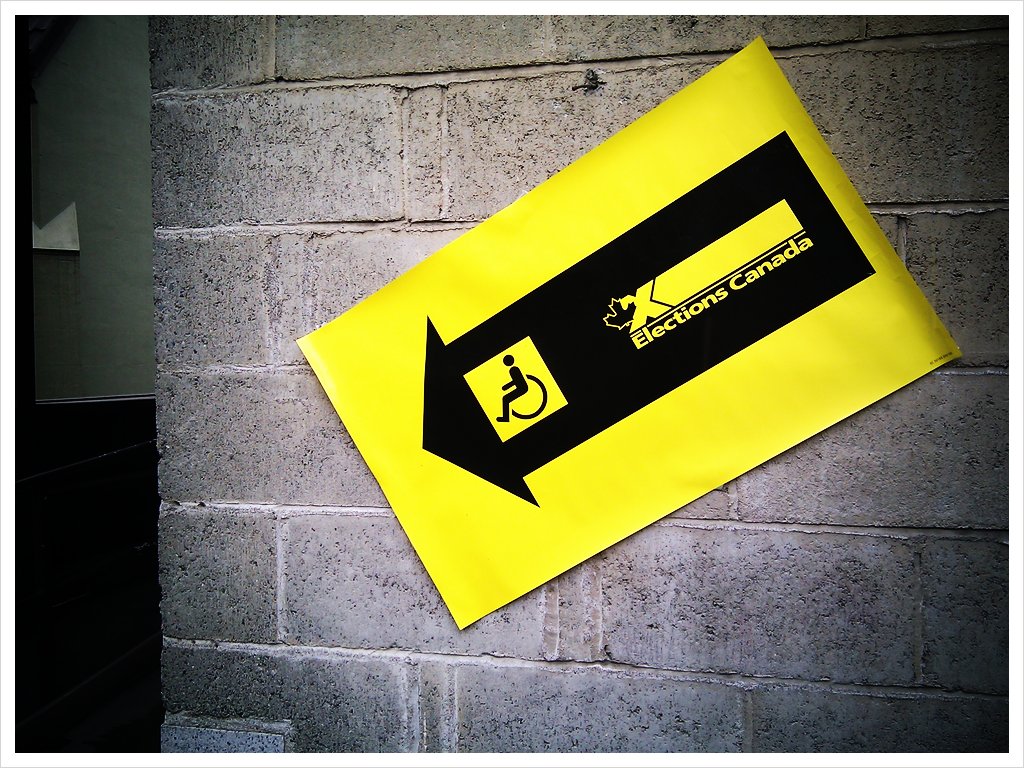 |
| Photo Description: The yellow Election's Canada sign pointing to a polling station. The disability access symbol is on the sign, which is pointing downwards. |
We were informed about the 'special ballot' voting in a mailing that we received from Elections Canada. What was cool about that mailing was that it had a list of the accessibility features of both the advance poll and the voting day polling stations. I popped over to the accessibility page on the Elections Canada website and was pretty impressed. I really liked being able to type in my postal code and find out everything I needed to know about polling stations. I found the list of mandatory (and preferred) features used in selection polling stations interesting. I liked the fact that accessibility was more than just getting in, there was information on assistance with marking a ballot and for sign language, amongst other languages, and that they could take requests in 110 languages.
We arrived just a little after one and went through the voting process, which is different, but not difficult, we discovered for 'special ballots' and then slammed our vote into the voting box. The whole thing was easy because access was simply an 'of course' and there was nothing to worry about. I will admit, though, when it came our turn, I asked Joe to go first just to check out the area for accessibility, I have a large chair after all. In the end Joe was still in, finishing up voting, when it came to be my turn. It was the same woman who had come to get Joe and when I was in her office having my ID checked, I relaxed.
It was an "of course."
I voted, freely - which means something a little different for a disabled voter.
Sunday, October 04, 2015
The Disability Voice
I heard his voice. Not because he was yelling, or because he was being unduly loud, but because he was speaking with quiet emphasis.
I knew, without seeing him, that he was a wheelchair user. Not because he, or the party he was speaking to made reference to the chair, but because of the words he was using.
I could not hear the other person but I knew that they were a non-disabled person desperately wanting to help. I knew this only because of the tone and the words of the person whose speech I could hear.
We were grocery shopping and I was coming up an aisle that would end just where the fridges are for milk when I heard him speaking. He spoke with the "disability voice" which combines these features:
-- gentle insistence that rose to firm insistence that was precisely calculated such that it couldn't be considered rude
-- just the right amount of gratitude for an offer of help that was being turned down
-- a tone of voice that said both 'I appreciate your offer of help' and 'I don't need your offer of help'
-- weariness at having to say the same words over and over again
-- a slight, almost not noticeable, anger that didn't know where to go because he was turning down someone's determined and insistent kindness
I came round the corner, and sure enough, there was a man with a disability with a bag of three bags of milk in his hands and a store basket on his lap. He looked over at me, I looked at him, he said, "Hi, how are you?" like we were old friends. I greeted him back. At that the other person said, "Well, if you are sure you're OK, I'll leave you to talk to your friend," then quickly left.
"Thanks," he said.
"No biggie," I said.
He put the milk into the basket and off he went, without needing a lick of help.
I knew, without seeing him, that he was a wheelchair user. Not because he, or the party he was speaking to made reference to the chair, but because of the words he was using.
I could not hear the other person but I knew that they were a non-disabled person desperately wanting to help. I knew this only because of the tone and the words of the person whose speech I could hear.
We were grocery shopping and I was coming up an aisle that would end just where the fridges are for milk when I heard him speaking. He spoke with the "disability voice" which combines these features:
-- gentle insistence that rose to firm insistence that was precisely calculated such that it couldn't be considered rude
-- just the right amount of gratitude for an offer of help that was being turned down
-- a tone of voice that said both 'I appreciate your offer of help' and 'I don't need your offer of help'
-- weariness at having to say the same words over and over again
-- a slight, almost not noticeable, anger that didn't know where to go because he was turning down someone's determined and insistent kindness
I came round the corner, and sure enough, there was a man with a disability with a bag of three bags of milk in his hands and a store basket on his lap. He looked over at me, I looked at him, he said, "Hi, how are you?" like we were old friends. I greeted him back. At that the other person said, "Well, if you are sure you're OK, I'll leave you to talk to your friend," then quickly left.
"Thanks," he said.
"No biggie," I said.
He put the milk into the basket and off he went, without needing a lick of help.
Saturday, October 03, 2015
Jeopardy Bound
| Photo description: cartoon of a person tied into a wheelchair with the words: Wheelchair bound? OR Person who uses a wheelchair |
I caught enough of it to know that the term was used descriptively, in the present tense, and wasn't referring to the dim dark past where terms like that were routinely used. Before I could react with words, Joe reacted with a more guttural form of 'egad!' Somehow, without any real reason, we thought Jeopardy would be more evolved in its understanding of language and of the impact of language.
Here's a show with a huge reach, using language which depicts disability in an archaic manner. Our fight for language which represents us rather than demeans us is far from over. As a wheelchair user myself, I find the term 'wheelchair bound' offensive primarily because the image it brings to mind is inaccurate. I am not bound by the chair, I'm freed by it. It gives me the life I live. But I don't need to tell any of you that, do I?
I posted this on Facebook when it first happened and many have suggested that I write Jeopardy. I have done so.
I'm now asking you, if you saw the show and that kind of language bothers you as it does me, or if this blog is enough to motivate you, drop them a line. The show was on October 2nd ... so ... here's the link: Jeopardy
Friday, October 02, 2015
Without Legs!?!
| Photo Description: Teen With Down Syndrome on Everest |
Thursday, October 01, 2015
She Said
 |
| Photo Description: Child's wheelchair, metal frame is bright yellow. |
I was caught in the same line-up.
The wait seemed interminable.
The clerk, slow and bored.
Two spaces ahead of me were a young mother with her boy.
He sat in a jolly, really jolly, bright yellow wheelchair.
He was bored.
I was bored.
We were all bored.
"What's wrong, Mommy," he asked.
"I'm just tired," she said.
After a pause he said, "I wish you had a chair to sit in like me."
She smiled.
The woman between mom and child and me, said, "He doesn't understand what he's saying."
Mother.
Turned.
"Yes.
He.
Does."
She said.
Wednesday, September 30, 2015
Hmmm, The Future?
As I mentioned yesterday, Joe and I had arranged a leisurely day off between traveling and lecturing. We got up that morning and had time to read, mess about on the computer, linger over tea and breakfast, it was a great start to the day. We then decided that we'd catch an movie, the one we wanted to see started at 11:40 am, a perfect time for us, so as it got closer to the time, we headed out.
And ended up having a very odd, a bit disquieting, but wonderfully hopeful, adventure.
The mall, itself, was perfectly accessible. I mean PERFECTLY. For example, when you pushed the auto door opener, both large doors slowly swept open leaving lots and lots of room to go through.We felted as if the mall had thrown it's arms open to us, welcoming us in. We headed to the movie theatre and saw Everest, a literally chilling movie, and then had a late lunch and wandered about. Here's what we encountered:
- a restaurant that had a sign up stating that they were able to substitute veggie chicken for real chicken in any of the dishes that they had. Their menu was varied and fully catered towards meat eaters, vegetarians and vegans.
- in the same restaurant seating was available at various heights, making it perfect for me in a tall chair.
- a tee shirt store that had all sorts of tee shirts hung up on display, two of which had rainbow flag motifs with the word 'pride' on them
- a movie theatre that had it's accessibility policy displayed right at the box office, including stating that for persons with disabilities who had a support staff, the support staff would not be charged
- staff in store were the picture of diversity, and that picture, as isn't typical, included those who had both physical and intellectual disabilities
It was simply, and oddly, amazing.
I say it was disquieting because I'm not used to being in a place where welcome is just naturally present. Nothing seemed forced, nothing was done to draw attention to the various ways that the mall was inclusive. It just was.
It just was.
As Joe and I were stopped in our tracks looking at the LGBT tee shirts, I said to Joe, "I don't know how to feel, I'm so used to feeling unsafe as a gay person or unwelcome as a disabled person that I don't know how to react to this place. It's disquieting in a strange way."
Joe agreed.
It's like this is the future we imagined, we fought for, and now that we stumbled into it, it's hard to believe it's true.
But it was.
It was hard to leave to go back to the hotel.
And ended up having a very odd, a bit disquieting, but wonderfully hopeful, adventure.
The mall, itself, was perfectly accessible. I mean PERFECTLY. For example, when you pushed the auto door opener, both large doors slowly swept open leaving lots and lots of room to go through.We felted as if the mall had thrown it's arms open to us, welcoming us in. We headed to the movie theatre and saw Everest, a literally chilling movie, and then had a late lunch and wandered about. Here's what we encountered:
- a restaurant that had a sign up stating that they were able to substitute veggie chicken for real chicken in any of the dishes that they had. Their menu was varied and fully catered towards meat eaters, vegetarians and vegans.
- in the same restaurant seating was available at various heights, making it perfect for me in a tall chair.
- a tee shirt store that had all sorts of tee shirts hung up on display, two of which had rainbow flag motifs with the word 'pride' on them
- a movie theatre that had it's accessibility policy displayed right at the box office, including stating that for persons with disabilities who had a support staff, the support staff would not be charged
- staff in store were the picture of diversity, and that picture, as isn't typical, included those who had both physical and intellectual disabilities
It was simply, and oddly, amazing.
I say it was disquieting because I'm not used to being in a place where welcome is just naturally present. Nothing seemed forced, nothing was done to draw attention to the various ways that the mall was inclusive. It just was.
It just was.
As Joe and I were stopped in our tracks looking at the LGBT tee shirts, I said to Joe, "I don't know how to feel, I'm so used to feeling unsafe as a gay person or unwelcome as a disabled person that I don't know how to react to this place. It's disquieting in a strange way."
Joe agreed.
It's like this is the future we imagined, we fought for, and now that we stumbled into it, it's hard to believe it's true.
But it was.
It was hard to leave to go back to the hotel.
Subscribe to:
Posts (Atom)